
Summary
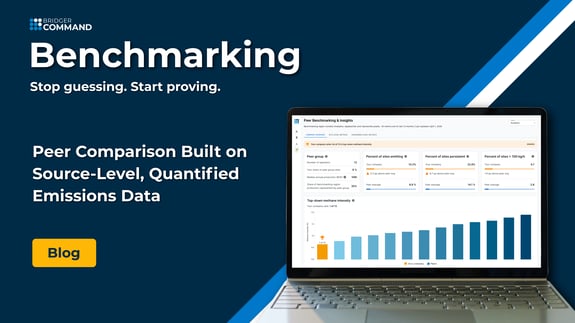
Bridger Benchmarking is the industry’s first and only emissions peer comparison product built on source-level, quantified methane measurement data. Delivered through Bridger Command™, it gives operators a measurement-based view of their emissions performance relative to comparable peers. Rolling metrics, updated monthly, allow operators to understand their position at a company, site, and equipment level. These insights enable focused mitigation on the assets that matter most, and demonstrate measurable progress to leadership, investors, and buyers.
Key Takeaways
- Bridger Benchmarking provides peer comparisons built on source-level, quantified methane measurement data
- Operators can evaluate performance at the company, site, and down to the equipment level
- Rolling 12-month metrics are updated monthly
- Relevant peer groups support meaningful, anonymized comparisons
- Detailed insights help operators prioritize mitigation and prove progress over time
How Do You Benchmark Emissions Performance Against Your Peers?
Energy operators have access to more methane emissions data than ever before. As emissions management programs mature, however, operators and stakeholders often ask: How does our emissions performance compare to our peers?
Many operators set emissions reduction or methane-intensity targets, or broader goals for improving their position relative to industry peers. But without a consistent, measurement-based point of comparison, it can be difficult to know whether those efforts are delivering the intended results.
Bridger Benchmarking fills that gap, introducing a unique, high-resolution approach to peer emission comparisons. Built on trusted, source-level methane measurement, Benchmarking data allows operators to see where they stand, understand what is driving their position, and determine where to focus efforts next.
What is Bridger Benchmarking?
Bridger Benchmarking is a new product developed from customer feedback and delivered within Bridger Command™.
Rather than providing a single annual score, Benchmarking uses rolling 12-month metrics that are updated monthly. This gives operators a more current and continuous view of their performance as new measurement-based emissions data becomes available.
Peer groups are developed to provide relevant comparisons among assets operating under similar conditions, using factors such as basin geography and gas-to-oil ratio. Outputs are anonymized, and peer groups are designed to protect customer confidentiality and reduce the risk of reverse identification.
The result is a high-resolution methane emissions benchmarking product that helps operators assess performance among peers with greater clarity and confidence.
What Can an Emissions Benchmarking Product Tell You About Your Performance?
Benchmarking begins by answering a straightforward question: Where do we stand relative to our peers?
Operators can evaluate their emissions performance at three levels:
- Company-level: Understand overall performance across the organization
- Site-level: See which facilities are strengthening or lowering the company’s position
- Equipment-level: Evaluate performance across equipment categories such as tanks, separators, wells, compressors, and flares
This level of detail provides operators the context needed to explain their results and understand how performance varies across their asset portfolio.
Because Bridger’s emissions benchmarking product is grounded in quantified measurement, teams gain a measurement-based view that can inform internal planning, executive discussions, sustainability reporting, and conversations with investors or buyers.
Focus Where It Matters
Bridger Benchmarking drills down from the company level to the sites and equipment categories influencing emissions performance. Operators can identify which portions of their asset base are performing well, which are falling behind comparable peers, and where focused action may have the greatest effect on emissions reduction.
This creates a stronger connection between emissions measurement and resource allocation. Rather than spreading mitigation efforts broadly or reacting to the most visible issue, teams can direct time and budget toward the assets and equipment groups with the greatest opportunity for improvement.
Benchmarking helps operators move from knowing they have a performance gap to understanding what is driving it.
Prove Emissions Reduction Progress Over Time
Operators are increasingly asked to support performance claims with credible evidence. Leadership teams want to know whether investments are working. Investors and buyers may want to understand how a company compares with its peers. Emissions teams need reliable metrics that demonstrate progress without creating another reporting burden.
Bridger Benchmarking provides rolling, measurement-based metrics to help with just that. Because the data is refreshed monthly, operators can follow changes over time, rather than waiting for an annual industry report.
This view helps teams determine whether mitigation strategies are improving performance, show how their position has changed, and support informed answers when internal or external stakeholders ask for evidence.
Anyone can set an emissions reduction goal. Bridger Benchmarking helps operators demonstrate whether they are achieving it with measurement-based data..
From Measurement to Performance
Effective emissions management requires more than finding and quantifying emissions. Operators also need to understand what the data says about overall emissions performance, where improvement is most needed, and whether their strategies are working.
Bridger Benchmarking provides that context. By combining source-level, quantified data, relevant peer emissions comparisons, detailed asset insights, and rolling metrics, it gives operators a clear path from emissions data to developing operational priorities and measuring progress.
Unlock Your Benchmark