Case Study
Cleanaway Strengthens Landfill Methane Measurement and Reduction with Aerial LiDAR
.png)
About the Case Study
Australia’s leading waste management and resource recovery company, Cleanaway Waste Management, is using Bridger’s aerial methane detection technology to pinpoint landfill emissions and guide targeted improvements. At Melbourne Regional Landfill, this approach helped reduce emissions identified for reduction by more than 80%.
The Result
80% Reduction in emissions identified at the Melbourne Regional Landfill
Pinpointed methane emissions sources and quantification; targeted repairs and operational improvements; more than 80% reduction in the emissions identified for reduction at Melbourne Regional Landfill.
Challenge:
Landfill operators have traditionally relied on standard estimation methods to report methane emissions. These estimates do not provide the detailed, site-specific information operators need to understand precisely how much methane is leaving a landfill or where individual emissions originate.
Recent changes by Australia’s Department of Climate Change, Energy, the Environment and Water recently modernized a landfill reporting methodology (Method 2), enabling landfill operators to use direct measurement to report methane emissions from landfills. This change enabled Cleanaway Waste Management (Cleanaway) to utilize Bridger’s advanced methane detection data to improve its understanding of emissions and guide practical reduction initiatives.
Approach:
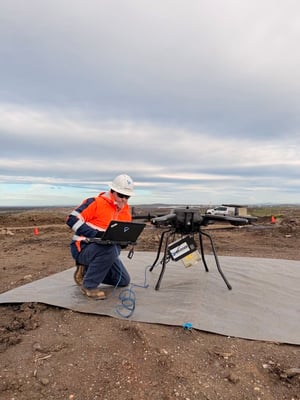
Cleanaway partnered with Bridger to measure methane emissions across its landfill sites using advanced aerial LiDAR technology deployed via UAV.
Bridger’s technology detects, quantifies, and pinpoints methane emissions across an entire landfill, providing broad, site-wide visibility into emissions and their individual source locations. These measurements allow Cleanaway to identify target zones for improvement, such as improving landfill cover, and optimizing landfill gas collection systems.
Why Bridger’s UAV Technology?
Landfill methane emissions can be distributed across broad and sometimes difficult-to-access areas. Bridger’s advanced UAV-deployed methane detection technology enables an efficient scan of the site while identifying pinpoint source locations and quantified emission rates.
This approach helps operators direct resources toward the most meaningful reduction opportunities, and evaluate the impact of operational improvements for emissions mitigation.
Key Takeaway
Bridger data gives landfill operators the site-specific intelligence needed to move beyond standard estimates, prioritize the most significant emission sources, and take action at targeted zones for improvement. By combining measurement-based emissions data with operational improvements, Cleanaway is building a more informed and effective approach to landfill methane reduction.
Results reflect one customer's specific program and aren't a performance guarantee for other engagements. Individual results may vary based on site conditions, operating practices, and other factors, and past performance does not guarantee future results.
Business Impact
Reduction of more than 80%
of the emissions identified for reduction at the Melbourne Regional Landfill
Site-Wide Emissions Visibility
Site-wide visibility into the location and magnitude of individual emission sources across surveyed Cleanaway landfill sites
Targeted Repairs and Operations
More targeted repair zones and operational improvements
Optimized Cover and Gas Collection
Well-informed operational improvements to landfill cover and gas collection systems